You flip a coin to settle a bet. It lands heads. You flip again and it lands heads again. By the third flip, someone at the table says "it must be tails this time." They are wrong, and the mistake reveals something most people do not know about how coin flips actually work.
The coin flip tool at ToolCenterHub gives a true 50-50 result using cryptographic randomness. Understanding why that matters, and why a physical coin flip is not actually 50-50, changes how you should think about when to use a digital flip versus a physical one.
This guide covers the real probability behind coin flips, what peer-reviewed research says about physical coin bias, how consecutive flip probability is calculated, and why digital coin flips are more defensible for situations where the result needs to be trusted by both parties.
Is a Coin Flip Actually 50-50?
The theoretical probability is exactly 50% for heads and 50% for tails on any fair coin. This is what most people learn, and most articles stop there.
The more complete answer: it depends on whether the coin is physical or digital.
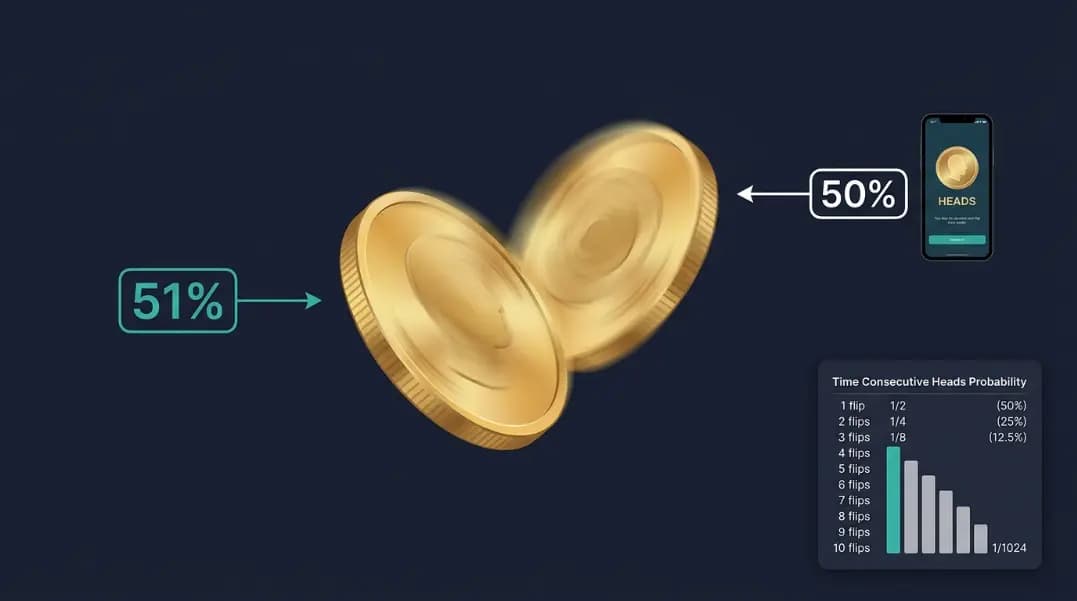
For a physical coin, a Stanford research team led by Persi Diaconis found that the result is not exactly 50-50 in practice. The bias runs at approximately 51% for whichever side faces up before the flip. Over millions of flips, that 1% difference becomes statistically measurable.
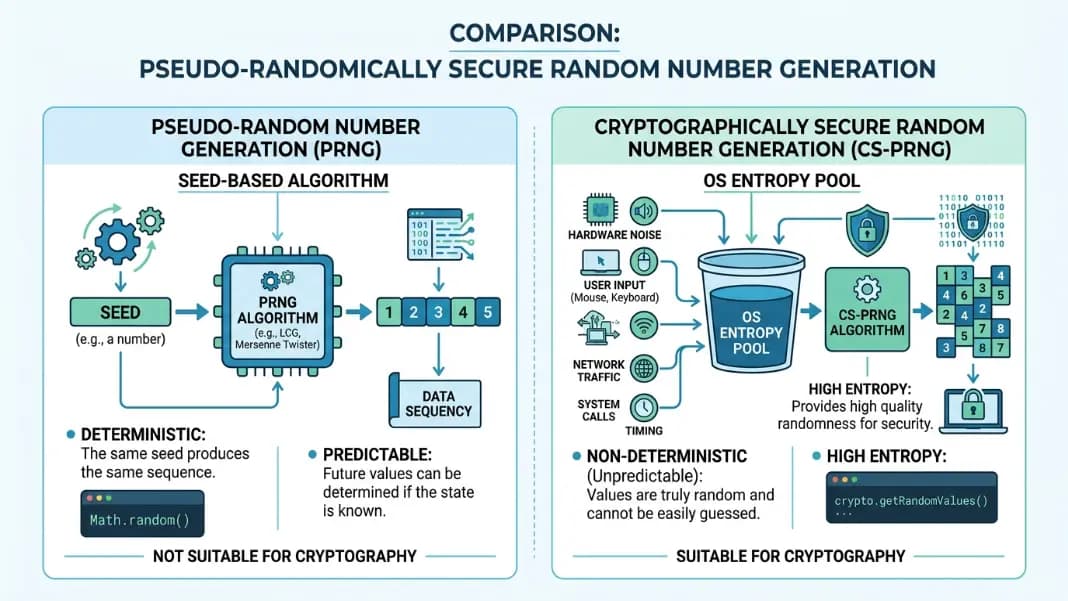
For a digital coin flip using a cryptographic random source, the probability is exactly 50% for each outcome with no mechanism for bias. There is no physical object, no precession, no muscle memory involved. The result is a number from a hardware entropy source, not a physics problem.
Why Physical Coins Are Biased
The key finding from Diaconis, Holmes, and Montgomery's research (SIAM Review, 2007) is that coins do not flip end-over-end cleanly. They precess.
Precession is the wobble a spinning object makes around its axis. A coin spinning on a table as it slows down wobbles before it falls. A hand-flipped coin does something similar in the air. As it rotates, it wobbles around its central axis in a way that causes it to spend slightly more time with the starting side facing up before landing.
This is not a weight distribution problem. Both sides of a coin weigh essentially the same. The bias is purely mechanical, a result of how human hands generate rotation. It appears in virtually every physical coin regardless of denomination or country of origin because it is a property of the flip mechanics, not the coin itself.
The practical consequence: if someone positions a coin heads-up before flipping, it will land heads approximately 51% of the time. This is a small but real and consistent bias that cannot be eliminated without a mechanical device that generates perfect rotation.
| Condition | Heads Probability | Source |
|---|---|---|
| Theoretical fair coin | 50.00% | Mathematical definition |
| Physical coin flip | ~51% same-side | Diaconis et al., SIAM Review 2007 |
| Controlled flipper (trained) | Up to 75%+ | Diaconis demonstration |
| Digital cryptographic flip | 50.00% exactly | crypto.getRandomValues specification |
Can You Predict or Control a Physical Coin Flip?
Persi Diaconis is both a Stanford statistics professor and a former professional magician. He demonstrated through controlled practice that a trained flipper can achieve heads rates of 75% or higher by controlling three variables: thumb force (determining rotational speed), catch height (determining how many rotations occur before catching), and whether they look ahead of time (coordinating catch timing to the flip count).
This is not widely achievable. It requires deliberate physical training over time. But it demonstrates that a physical coin flip between two parties, where one party controls the flip, is not a neutral randomizer.
A digital coin flip has no such vulnerability. The result is generated by the browser's cryptographic engine from hardware-derived entropy. There is no sequence to control, no timing to manipulate, no thumb position to optimize. Even the software generating the flip cannot predict its own output before running. The mechanics behind this are covered in detail in the guide to how online random generators actually work.
Consecutive Flips and the Gambler's Fallacy
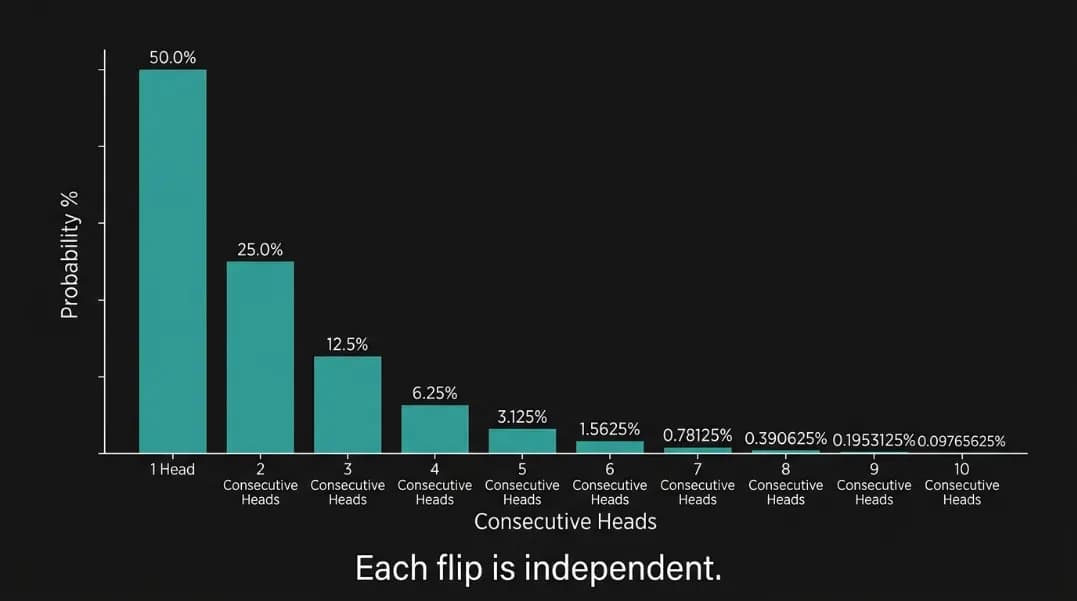
The gambler's fallacy is the belief that past results affect future independent events. If a coin lands heads five times in a row, the fallacy says tails is "due." Probability says: tails is exactly as likely as heads on the next flip, as if the previous five flips never happened.
Each flip is statistically independent. The coin has no memory. The probability of the next flip is always 50% (digital) or approximately 51% same-side (physical), regardless of the preceding streak.
What changes with consecutive flips is the probability of the complete sequence occurring. Getting heads 10 times in a row requires each of those 10 independent 50% events to all land the same way.
| Consecutive heads | Probability | Odds |
|---|---|---|
| 1 | 50.00% | 1 in 2 |
| 2 | 25.00% | 1 in 4 |
| 3 | 12.50% | 1 in 8 |
| 5 | 3.13% | 1 in 32 |
| 10 | 0.098% | 1 in 1,024 |
| 15 | 0.003% | 1 in 32,768 |
| 20 | 0.0001% | 1 in 1,048,576 |
These probabilities look dramatic, but they do not mean tails is "due" after a streak. The sequence HHHHHHHHHH and the sequence HTHTHTHTHTHT have exactly the same probability of occurring: each is one specific sequence of 10 independent 50/50 events, and every such sequence is equally likely.
The law of large numbers says that over thousands of flips, the proportion of heads approaches 50%. This is true. But it does not work through a compensating mechanism on individual flips. It works because 50% probability on every flip produces converging proportions in large samples, not because the coin "corrects" a streak.
Why Digital Coin Flips Are Fairer for Recorded Decisions
The random coin flip guide covers how digital coin flips work mechanically. The short version: the browser generates a result from hardware-derived entropy using the Web Cryptography API, drawing from timing jitter, hardware sensor noise, and operating system randomness sources.
The reason this matters for recorded decisions, such as a tournament coin toss over video call, a giveaway winner selection, or a public bet settlement:
Physical flips are controlled by one party. Digital flips are controlled by neither party. Anyone watching the screen sees the same result at the same moment. Screenshots capture the result with a timestamp. Neither party touched anything after the flip was initiated.
For the case where the two parties also want a visual spin format rather than a flip animation, the yes or no wheel achieves a similar neutral outcome with a different visual mechanic. The random decision maker guide covers which format works better for different types of binary decisions.
How to Use the Coin Flip for Different Situations
Settling a simple binary dispute: Open the coin flip on a shared screen. Agree before flipping which outcome each party takes. Flip once. Screenshots document the result if needed.
Running best-of sequences: If a game requires first to three heads wins, run sequential flips and track results verbally as they land. The tool shows each flip result individually, so results can be called out in sequence without confusion.
Remote sports decisions: Teams running an electronic coin toss over video call should share the screen before flipping, so both sides see the flip initiate and the result simultaneously. This removes any possibility of the screen-sharer generating multiple results and displaying only a favorable one.
Teaching probability: Running 100 flips and recording results demonstrates the law of large numbers directly. At 20 flips, the proportion may be significantly off 50/50. At 100, it will be closer. This is a practical demonstration requiring no physical coins, with results that are repeatable and auditable.
When Physical Coins Are the Right Choice
A digital flip is better for fairness and documentation. A physical coin is better for experience.
Flipping a physical coin at the start of a backyard game, a family dispute, or a casual bet has a ritual quality that a phone screen does not replicate. The anticipation of the flip, the sound of the coin, and the group's physical reaction to the result are part of what makes coin flips work socially. For those situations, the 1% same-side bias does not matter.
The bias matters when the flip is consequential: a tournament seed, a public giveaway, a financial decision. In those cases, the party controlling the physical flip has a small but real and documented advantage. A digital flip on a neutral platform removes that advantage entirely and produces a result that both parties witnessed being generated, not just reported.