You are three sessions into a campaign and the D12 is under the couch. Or you are running a game over a video call and four people are trying to trust each other's unverifiable rolls. Or you need to roll 8D6 and track the individual results quickly. A physical dice set handles none of these situations well.
The dice roller at ToolCenterHub supports the full standard polyhedral set from D4 to D100. Each roll draws from a cryptographic entropy source, and multiple dice of the same type can be rolled simultaneously with individual results displayed alongside the total.
This guide covers how digital dice work mechanically, the probability distributions behind each die type, why rolling 2D6 is fundamentally different from rolling 1D12, and when digital dice are more reliable than physical ones.
How Does an Online Dice Roller Work?
An online dice roller picks a random integer from 1 to the face count of the selected die. On a D6, that is 1 to 6. On a D20, 1 to 20. On a D100, 1 to 100.
The randomization comes from the browser's crypto.getRandomValues() Web Cryptography API. This API draws from a hardware-seeded entropy source using timing jitter, hardware sensor noise, and operating system randomness. The result is cryptographically secure: statistically unpredictable by any observer, including the software itself.
This is a different source than JavaScript's Math.random(), which generates numbers from an algorithmic pseudo-random sequence. Math.random() can produce statistically detectable patterns over many rolls because the sequence is deterministic from its seed. Cryptographic entropy has no such pattern. The full explanation of what makes these two sources different is in the guide to how online random generators work.
What Are the Standard Polyhedral Dice?
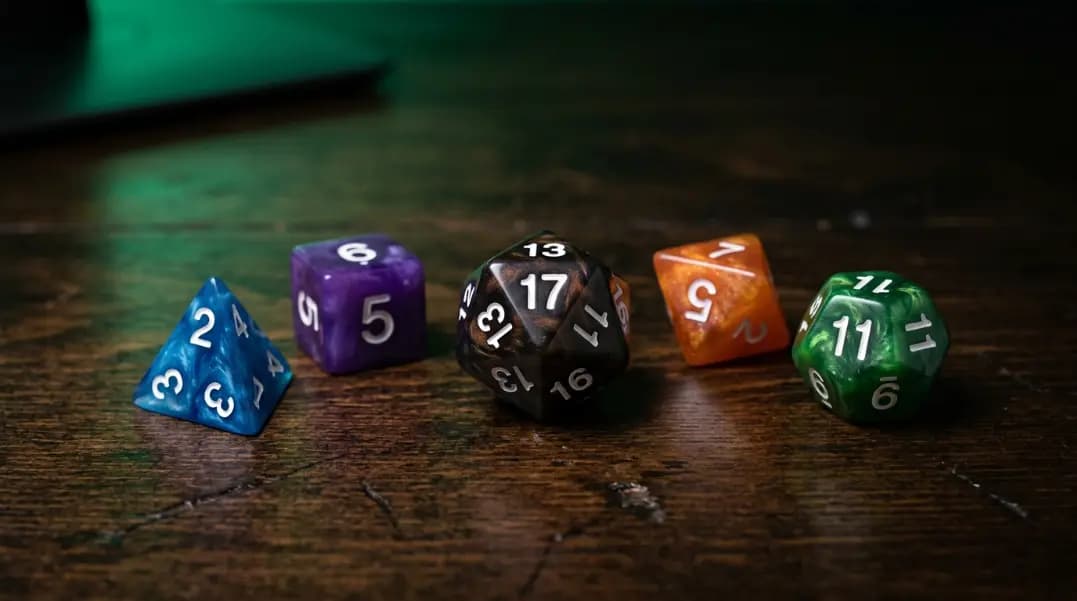
The seven standard polyhedral dice are defined by their geometry and face count. Each appears in tabletop RPG systems, board games, and probability exercises.
| Die | Faces | Range | Primary Use |
|---|---|---|---|
| D4 | 4 | 1-4 | Damage for daggers, darts; small random increments |
| D6 | 6 | 1-6 | Standard game die; most common in board games |
| D8 | 8 | 1-8 | Damage for longswords, handaxes in D&D |
| D10 | 10 | 1-10 (or 0-9) | Percentile rolls (used in pairs as D100) |
| D12 | 12 | 1-12 | Damage for greataxes; often used as a flat range |
| D20 | 20 | 1-20 | Core resolution die for Dungeons and Dragons; flat probability |
| D100 | 100 | 1-100 | Percentile rolls for skills, critical hit tables, rare events |
All of these dice produce a flat (uniform) distribution when rolled once. Every face on a given die has exactly the same probability of appearing.
The D10 is occasionally labeled 0 through 9 rather than 1 through 10. In that case, 0 represents 10. Two D10 dice together produce a D100: one represents the tens digit and one represents the units digit.
Why Does Rolling 2D6 Produce Different Results Than 1D12?
This is the most important probability concept in tabletop gaming and the one most commonly misunderstood.
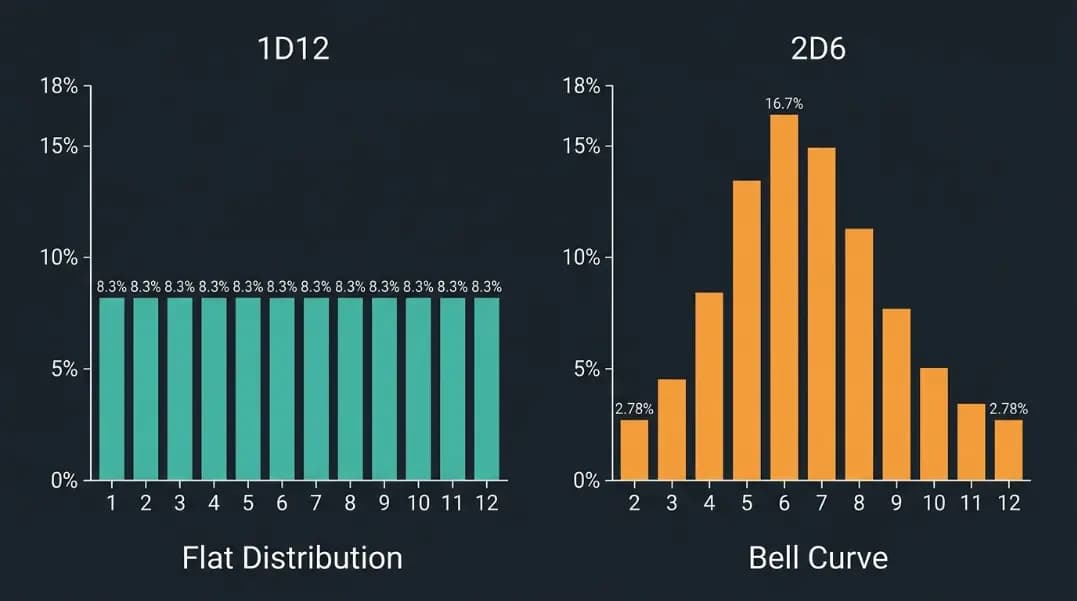
Rolling a single D12 produces a flat distribution. Every value from 1 to 12 has an 8.33 percent chance on every roll.
Rolling two D6 dice and adding them produces a bell curve. The minimum result is 2 (both dice show 1) and the maximum is 12 (both show 6). But the value 7 can be made in six different ways: 1+6, 2+5, 3+4, 4+3, 5+2, and 6+1. Each of those combinations is equally likely, so 7 appears six times as often as 2 or 12.
| 2D6 Total | Ways to Make It | Probability |
|---|---|---|
| 2 | 1 (1+1) | 2.78% |
| 3 | 2 (1+2, 2+1) | 5.56% |
| 4 | 3 | 8.33% |
| 5 | 4 | 11.11% |
| 6 | 5 | 13.89% |
| 7 | 6 | 16.67% |
| 8 | 5 | 13.89% |
| 9 | 4 | 11.11% |
| 10 | 3 | 8.33% |
| 11 | 2 | 5.56% |
| 12 | 1 (6+6) | 2.78% |
Game designers use multiple dice specifically to shape this curve. 2D6 produces results clustered near 7. 3D6 clusters near 10-11. Rolling 4D6 and dropping the lowest (the common character stat method in D&D) heavily skews results toward higher values, with the distribution peaking around 12-13.
A single die of any size produces a flat line. Multiple dice of the same size produce a curve. This is why the choice of dice in a game system shapes the feel of randomness: flat distribution means every outcome feels equally plausible, while bell curves mean average results are expected and extremes are surprising.
Is Digital Dice More Reliable Than Physical Dice?
For most tabletop gaming, digital dice are more consistently random than the physical dice most players own. The reason is manufacturing tolerance.
Consumer-grade dice are injection-molded plastic. The molding process creates small weight imbalances between faces because the recessed pips (the face markings on a D6, for example) remove material from some faces but not others. A D6 with pip-marked faces has slightly less material on the 6 face (which has six pits) than on the 1 face (one pit). Over thousands of rolls, this imbalance produces a measurable bias: 6 is slightly lighter, and lighter faces tend to land face-up more often.
Precision casino dice are machined to much tighter tolerances and have filled, painted pips rather than recessed ones. They hold statistical uniformity far better. But they cost $10-15 per die and most tabletop players do not use them.
Digital dice have no physical imperfection. The probability is programmed, not shaped by manufacturing variation. This does not mean digital dice are always the right choice (see the section on when to use each), but it does mean the distribution is mathematically correct regardless of how many times you roll.
Probability Reference for Common Dice Combinations
These are the roll probabilities most commonly referenced in tabletop gaming and board game design:
| Roll | Probability of Result | Notes |
|---|---|---|
| D20 critical hit (20) | 5% | 1 in 20 per roll |
| D20 critical fail (1) | 5% | Same odds as critical hit |
| 2D20 advantage (max ≥ 15) | 43.75% | Advantage doubles probability compared to single roll |
| D6 rolling 6 | 16.67% | 1 in 6 |
| 2D6 rolling exactly 7 | 16.67% | Most likely single result |
| 3D6 rolling 17 or 18 | 4.63% | Rare on character ability score rolls |
| D100 rolling 1-10 | 10% | 1 in 10 |
| D100 rolling 100 (or 00) | 1% | 1 in 100 |
Advantage in D&D 5th Edition means rolling two D20 and taking the higher result. The probability of rolling at least 15 on a single D20 is 30 percent. With advantage, the probability of getting at least 15 as the higher of two rolls is 1 minus the probability that BOTH rolls are below 15, which is 1 minus (14/20 × 14/20) = 1 minus 0.49 = 51 percent. Advantage is a substantial mechanical benefit.
When to Use Digital Dice vs Physical Dice
Digital dice work better for:
Remote play over video call. One player runs the dice roller and shares their screen. Everyone sees each roll simultaneously, removing trust issues around unverifiable physical rolls.
Missing or incomplete sets. If you need a D8 and the only one in the group is under a couch cushion, a digital roller solves the problem immediately.
Rolling large numbers of dice quickly. Rolling 10D6 for fireball damage in a physical set takes time to gather, throw, and count. The digital roller handles this in one click and displays each individual result.
Logging results. When a game session requires tracking many sequential rolls, screen-capturing or noting digital results is faster than manually recording physical rolls.
Physical dice work better for:
When tactile engagement is part of the experience. Many tabletop players value the physical ritual of rolling dice as part of the game atmosphere. A digital roller cannot replicate this.
When a group distrusts digital randomness. Some players have strong preferences for physical dice. If trust is the issue, using physical dice removes the argument.
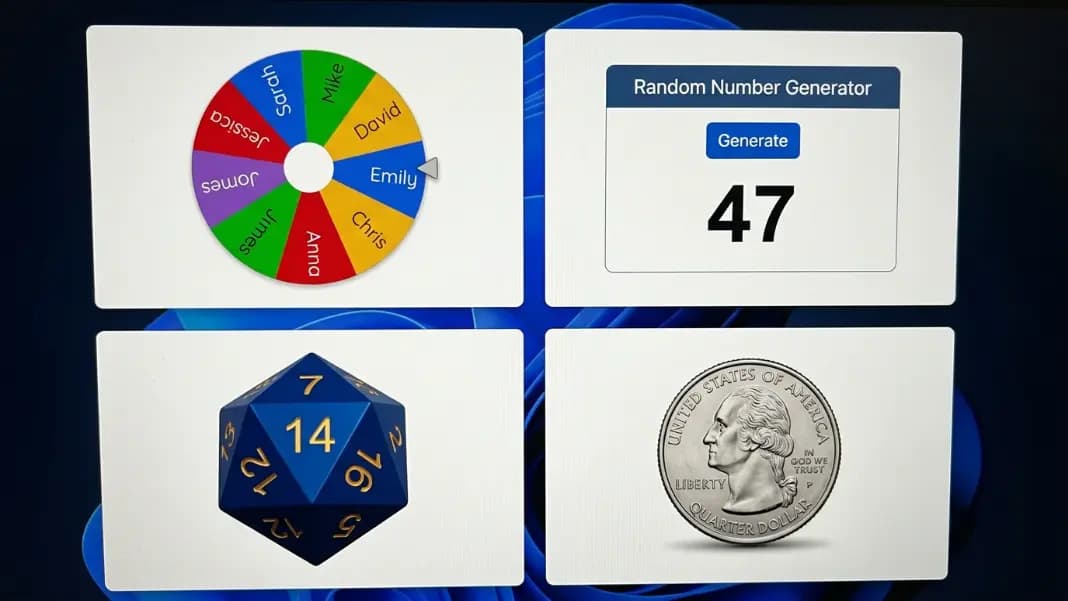
For comparison with other random tools, the wheel spinner is better for selection tasks (picking from a list of options) and the random number generator is better for arbitrary numeric ranges outside standard die face counts. The coin flip covers binary decisions faster than the dice roller for simple yes-or-no questions.
Running the Dice Roller for Tabletop RPGs
The most common use case is Dungeons and Dragons or similar d20-system games. The standard dice set needed is: D4, D6, D8, D10, D12, D20, and D100.
For a D&D session, the primary roll is always a D20 for attack rolls, ability checks, and saving throws. Damage rolls use the weapon's die type: a shortsword uses 1D6, a longsword uses 1D8 (or 1D10 in two hands), a greatsword uses 2D6, a greataxe uses 1D12.
For rolling character ability scores using the standard method (roll 4D6, drop the lowest, sum the remaining three), the dice roller handles the multi-die roll and displays individual results. Drop the lowest number manually before summing.
For percentile tables, the D100 represents a result from 1 to 100, equivalent to rolling two D10 and treating one as the tens digit and one as the units digit. The dice roller produces this as a single result directly.
The random number generator handles any custom range not covered by standard die types. If a game rule calls for a result from 1 to 37, the dice roller cannot produce that directly, but the number generator can.