You have read the strategy chart. You know the general rules: hit on 11 or less, stand on hard 17 or more, double when the opportunity is right. In the first few practice sessions it still goes wrong. Soft 18 comes up and you stand because 18 feels like a good hand. Hard 16 comes up against a dealer 10 and you freeze. The chart says one thing. Your instinct says another. Knowing the rule and deciding under pressure are two different skills.
The card picker lets you practice the decisions that matter before the instincts override the rules. Draw a hand, draw a dealer upcard, and apply the correct call. This guide focuses on the seven specific hand-upcard combinations where beginners deviate from basic strategy most often, with the mathematical reason behind each counterintuitive call: not just what the chart says, but why it says it.
Why the Strategy Chart Is Not Enough on Its Own
Basic strategy charts exist in every form: wallet-sized cards, mobile apps, printed posters. Every blackjack guide recommends memorizing one. Most beginners do read the chart. They still make the wrong call on soft 18, hard 16, and split situations because reading a chart and responding correctly under time pressure are separate skills.
The gap closes through repetition of the specific hands that cause hesitation. Practicing every hand equally is less effective than practicing the small set of hands where your instinct and the chart disagree. Those are the ones generating the largest gap between what you do and what basic strategy prescribes.
The seven decisions below are not the most common hands. They are the hands where the cost of deviation is highest and where beginners are most consistently wrong.
The 7 Decisions That Cost Beginners the Most
Decision 1: Soft 18 vs. Dealer 9, 10, or Ace
The instinct: Stand. Eighteen is a strong total.
Basic strategy: Hit.
Why: When the dealer shows 9, 10, or Ace, they are favored to end with 19, 20, or 21. Standing with 18 loses the majority of those outcomes. Hitting soft 18 costs nothing on the downside. The Ace adjusts from 11 to 1 if you draw a card that would otherwise push past 21, so you cannot bust on one hit from soft 18. Any card from Ace through 3 improves the total (to 19, 20, or 21). Cards 4 through 10 produce a hard total of 12 through 18, which is no worse than being stuck at 18 against a dealer heading for 19 or 20.
Against dealer 3 through 6, soft 18 becomes a double-down situation when doubling is allowed. Weak dealer upcards (3 to 6) bust more often, and doubling soft 18 extracts more value from a favorable situation.
Decision 2: Hard 16 vs. Dealer 7, 8, 9, 10, or Ace
The instinct: Stand. Drawing another card will bust the hand.
Basic strategy: Hit. Surrender if the option is available against 9, 10, or Ace.
Why: The fear of busting from 16 is real — any 6 through 10 value card (roughly 62 percent of draws) busts the hand. The problem is that standing with hard 16 against a dealer showing 7 through Ace is nearly as bad. Dealer 7 through Ace makes a 17 or higher without busting approximately 74 to 77 percent of the time. Standing at 16 loses all of those hands automatically, with no chance of improving. Hitting at least produces the occasional survival draw (Ace through 5), even though the bust rate is high.
Surrender (returning half the bet and conceding the hand) is mathematically better than either hitting or standing when dealer shows 9, 10, or Ace and your hand is hard 16. The expected loss from surrender is 50 percent of the bet. The expected loss from playing hard 16 against strong dealer cards is 60 to 70 percent of the bet. If the house offers surrender, take it on hard 16 against 9, 10, Ace.
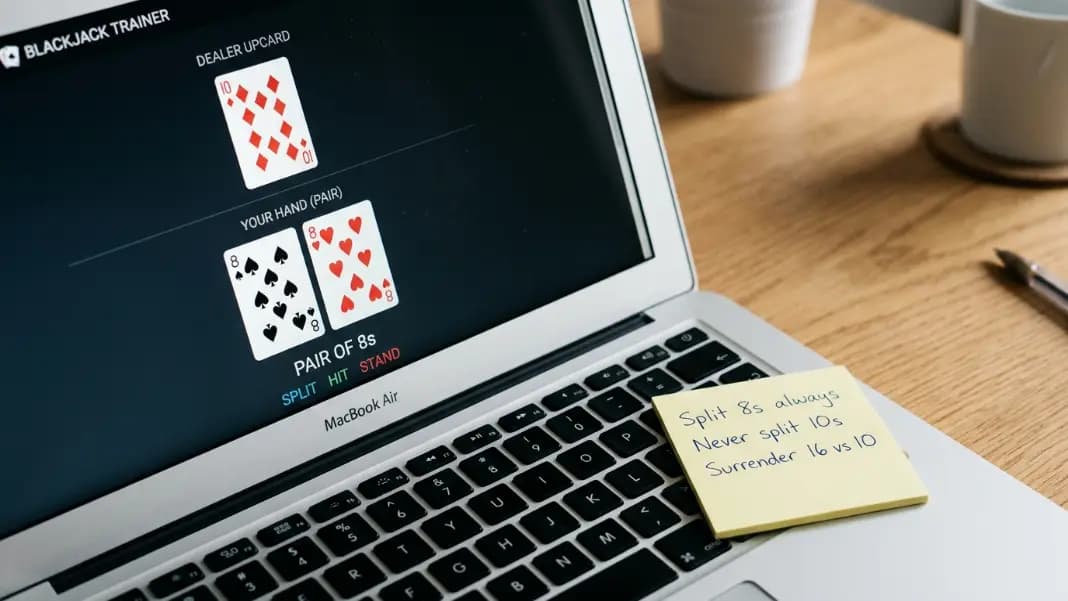
Decision 3: Always Split 8s, Including vs. Dealer 10 or Ace
The instinct: Against a dealer 10 or Ace, the split seems risky: you're doubling the money on the table against the strongest dealer cards.
Basic strategy: Always split 8s.
Why: Hard 16 is the worst starting hand in blackjack. Its expected value is deeply negative against every dealer upcard. Splitting 8s converts one hard-16 hand into two hands each starting at 8. Starting at 8 is a worse position than starting at 10 or 11, but it is substantially better than hard 16. The expected loss from two hands starting at 8 against a dealer 10 is lower than the expected loss from playing hard 16 against a dealer 10, even accounting for the additional bet on the split. The math holds consistently. Split 8s regardless of the dealer upcard.
Decision 4: Never Split 10s
The instinct: Two 10s could make two 20s. That seems better than one hand.
Basic strategy: Never split 10s.
Why: A hand totaling 20 wins approximately 85 percent of the time against a full shoe. It is one of the strongest hands in blackjack. Splitting 10s trades a near-certain win for two hands each starting at 10, which are good but not as strong as already having 20. The only dealer upcard that would justify splitting 10s would require an extraordinarily favorable deck composition, a situation that does not apply in standard play without card counting. Never split 10s.
Decision 5: Double Down on Hard 11 vs. Dealer 10
The instinct: The dealer is showing a strong card. Doubling against a dealer 10 feels dangerous.
Basic strategy: Double down.
Why: Starting with 11 means any 10-value card (10, Jack, Queen, King) produces 21. Ten-value cards make up 4 out of every 13 ranks, roughly 31 percent of the deck. Even against a dealer 10, the expected value of doubling with 11 exceeds the expected value of hitting, because the doubled stake applies when you draw a strong card. Against dealer upcards of 2 through 9, doubling 11 is even more clearly correct. The hesitation comes from the visible dealer strength, but the math does not support passing on the double.
Decision 6: Soft 17 Against Dealer 3 Through 6
The instinct: Stand. Seventeen is a complete hand.
Basic strategy: Double down if allowed. Otherwise hit.
Why: Dealer 3 through 6 are the weakest dealer upcards. The dealer busts most frequently from these starting points. Soft 17 (Ace + 6) cannot bust on one additional card. Doubling soft 17 against a weak dealer upcard doubles the stake in a situation where the dealer is likely to self-destruct. Hitting instead of standing (when doubling is not allowed) still improves expected value because soft 17 is not a strong enough total to justify standing and hoping the dealer busts independently.
Decision 7: Hard 12 vs. Dealer 2 or 3
The instinct: Stand. Any 10-value card busts the hand.
Basic strategy: Hit.
Why: Dealer 2 and 3 look weak on the surface, but they bust less often than dealer 4, 5, or 6. Dealer 2 busts roughly 35 percent of the time. Dealer 3 busts roughly 37 percent. Standing with 12 means losing to any dealer hand that reaches 13 through 21 without busting. That is the majority of dealer outcomes from 2 or 3. Hitting from 12 has a bust probability of approximately 31 percent (drawing any 10-value card). The expected value of hitting 12 against dealer 2 or 3 is higher than standing, because the dealer is not weak enough from 2 or 3 to justify surrender on standing.
Against dealer 4, 5, or 6, the correct play for hard 12 changes to stand. Those dealer upcards bust much more frequently, making it worth standing with a poor hand and waiting.
How to Practice These Decisions With a Card Picker
The card picker draws from a standard 52-card deck in sequence, the same as a physical dealt hand.
Practice session setup:
- Open the card picker and set it to a fresh deck.
- Draw two cards as your starting hand.
- Draw one card as the dealer upcard. Set it aside visible.
- Draw one card as the dealer hole card. Set it aside face down (do not use it yet).
- Apply the correct basic strategy decision based on your hand total and the dealer upcard alone.
- Draw additional cards if you hit. Stop when you stand, bust, or double.
- Reveal the dealer hole card. Draw for the dealer until their total reaches 17 or higher. Dealer stands on all 17s.
- Record the outcome: win, loss, or push.
Keep a printed basic strategy chart visible during early sessions. Checking the chart during practice is not a shortcut. The goal is to build correct associations through repetition, not to test your memory before you have had enough practice to form it.
Which hands to focus on: Every time one of the seven situations above appears, pause before applying the decision. Name the situation, state the correct call out loud, and then execute it. The pause and verbal identification reinforce the pattern more effectively than silent mechanical execution.
Tracking Your Weak Spots Over Sessions
Run 30 to 50 hands per session. After each session, review the decisions where you hesitated or checked the chart. Write the hand and upcard combination.
After three or four sessions, the hands where you hesitate consistently become visible. These are your current weak points. In the following session, spend the first 10 hands dealing yourself those specific combinations intentionally rather than drawing randomly. Force the soft 18 vs. 9 scenario, force the hard 16 vs. 10, force the 8-8 split.
The card picker allows this intentional practice. Reset the deck, draw your first card as an Ace, second card as a 7, dealer upcard as a 9. Apply the decision. Reset again. Repeat the same scenario five times in a row until the correct response becomes automatic rather than calculated.
When to reset the deck: For pure strategy practice, reset after every hand. This removes deck composition as a variable and isolates each decision. The card games with a deck of cards guide covers the reset vs. play-through distinction in detail: reset for strategy practice, play through for probability study.
When to Stop Consulting the Chart
Drop the chart when you can play 20 consecutive hands without checking it and the decisions on the seven scenarios above feel immediate rather than considered. That typically takes 150 to 300 hands of deliberate practice across multiple sessions, depending on how frequently the key situations come up.
At that point, the chart has moved from external reference to internalized pattern. New scenarios can still surprise you: splitting Aces, doubling soft hands against various upcards, surrender decisions on hands other than hard 16. Those come next. The seven situations above are the foundation, and the foundation needs to be automatic before the edge cases matter.
For the full set of card game formats that work alongside the card picker, the random card generator guide covers how the digital deck shuffles and sequences draws, which affects how you interpret results across a full practice session. For any additional random tool that pairs with card practice, the random tools section has the number generator for tracking point scores and session statistics.