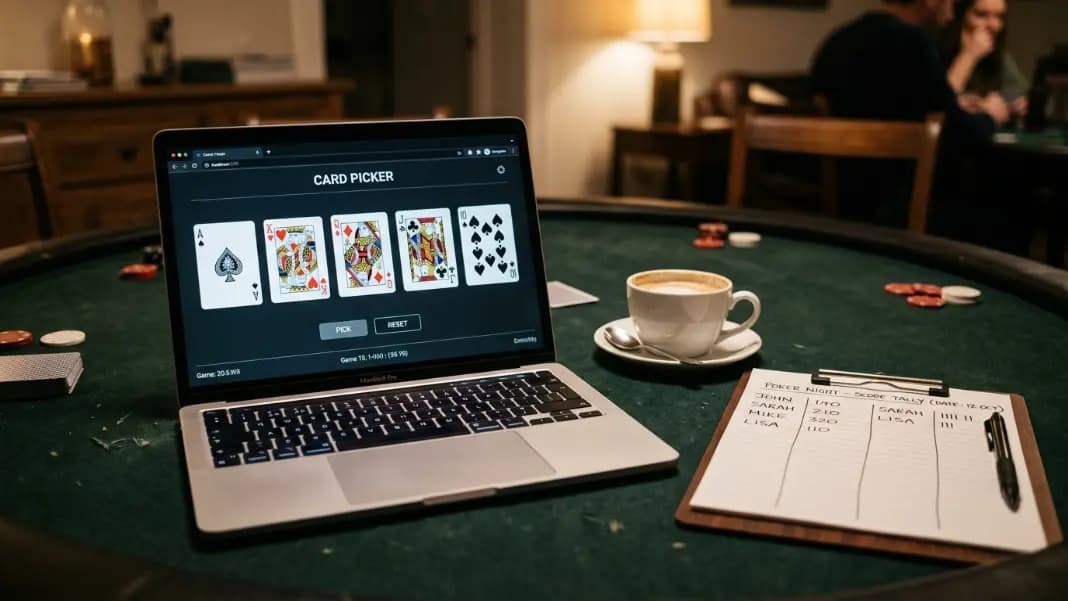
You do not need a physical deck, a table, or anyone in the same room to run a proper card game. A digital card picker handles the shuffling, drawing, and deck tracking in any browser with no download required. The seven formats below all work with the card picker as the only equipment.
Each format includes specific setup instructions and one decision most card game guides skip: when to reset the deck between hands and when to play through it. That choice changes the nature of the game more than most players realize.
How a Digital Deck Differs from a Physical Shuffle
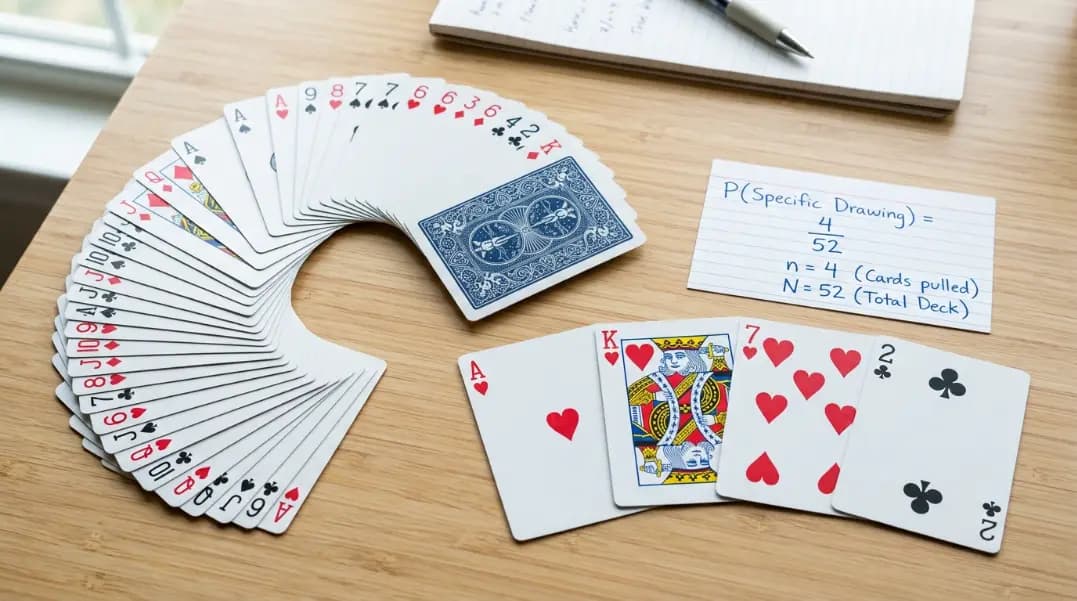
A physical 52-card deck requires seven complete riffle shuffles to reach full randomization. This was established by statisticians Persi Diaconis and Dave Bayer in a 1992 paper published in the Annals of Applied Probability. Most players do one to three riffles before dealing, which leaves statistical residue from the previous hand. Relative card positions are partially preserved from the last deal through the next shuffle.
A digital card picker applies a complete Fisher-Yates shuffle using a cryptographic entropy source at the start of every session. The shuffle is a full randomization with zero carry-over from previous draws.
For casual games between people who trust each other, this difference rarely matters. For practice sessions where you want to isolate pure strategy decisions from deck composition effects, the digital picker removes the shuffle variable entirely. The guide to how online random generators actually work covers the technical distinction between cryptographic and pseudo-random sources if you want more detail on what the picker is doing under the hood.
Game 1: Higher or Lower
Higher or Lower is the simplest format that works with a digital card picker and the best starting point for anyone unfamiliar with the tool.
Setup: Open the card picker. Agree on whether Aces count as 1 (below 2) or 14 (above King) before the first draw.
How to play:
- Draw one card. This is the starting card.
- Before drawing the next card, predict: higher or lower in face value?
- Draw. Check the prediction. Score 1 point for correct, 0 for incorrect, 0 for a tie.
- The drawn card becomes the new starting card for the next prediction.
- Continue until the deck runs out or a fixed round count completes.
Group format: Players take turns making the prediction before each draw. The person predicting calls their answer before the card appears. Highest score after 20 rounds wins.
Solo format: Track your accuracy across a full 52-card deck. A random guesser averages around 50 percent correct. After 26 draws, the remaining deck is weighted toward specific values, making probability-informed predictions more accurate than pure guessing. Tracking whether your accuracy improves in the second half of the deck versus the first shows whether you are picking up on depletion patterns.
Game 2: Blackjack Practice
Blackjack has a mathematically optimal decision for every combination of player hand and dealer upcard. The goal of Blackjack practice with a card picker is to internalize those decisions until they become automatic.
Setup: Open the card picker. Have the basic strategy chart for a single-deck game available as a reference during early sessions. Checking the chart during practice is not cheating: the goal is to memorize the decisions through repetition, not to simulate a real game.
How to play:
- Draw two cards as your starting hand. Total the value (face cards = 10, Aces = 1 or 11).
- Draw one card as the dealer's upcard (visible value known).
- Draw one card as the dealer's hole card (set aside face down).
- Based on your hand total and the dealer's upcard, decide: hit, stand, double down, or split if you have a pair.
- Draw for your hand as needed.
- After your hand resolves, reveal the dealer hole card. Draw for the dealer until their total reaches 17 or higher. Dealer stands on all 17s.
- Compare totals. Closer to 21 without going over wins.
Reset decision: For pure strategy practice, reset the deck after every hand. Every hand then starts from a full 52-card deck, removing card composition as a factor and isolating the strategy decision. For probability practice around how remaining deck composition shifts, play through without resetting and track which high-value cards (10s and Aces) have appeared.
Game 3: War
War runs between two players using the card picker managed by one neutral person as dealer.
Setup: One player controls the card picker. Agree on Ace value before starting. Either player can verify the draw by watching the screen.
How to play:
- The dealer draws one card for Player 1.
- The dealer draws one card for Player 2.
- Higher face value wins the round and scores 1 point. On a tie, both players score 0 for that round, or use the traditional war variant: each player draws two extra cards and the second one determines the war winner.
- Repeat for a fixed number of rounds, typically 20.
Remote format: One person shares the card picker screen on a video call and draws for both players. Both players see each draw simultaneously. The format is identical to in-person play with a dealer.
Why digital runs faster: Physical War requires cutting the deck before each draw and managing two separate piles. The digital picker draws randomly in one click with no pile management needed, which roughly doubles the game speed.
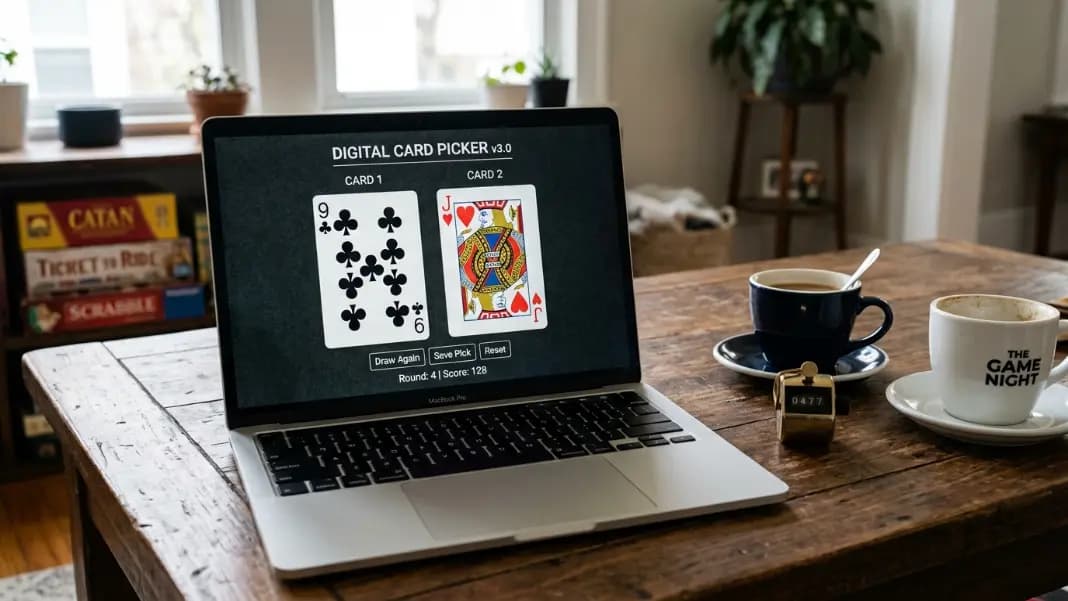
Game 4: Beat the Dealer
Beat the Dealer is a solo format designed specifically for Blackjack decision practice without needing a second person to run the dealer hand.
How to play:
- Draw two cards for your hand.
- Draw two cards for the dealer: one face-up and one face-down.
- Play your hand using basic strategy: hit, stand, double, or split based on your total and the dealer's upcard.
- After your hand resolves, reveal the dealer hole card and draw for the dealer until they reach 17.
- Record the outcome: win, loss, or push.
Tracking over sessions: Run 20 to 50 hands per session and note every decision where you checked the strategy chart. After 200 hands across multiple sessions, the hand-upcard combinations where you feel least confident become visible in your notes. These are the decisions that need the most repetition.
The combinations most players find hardest: soft 18 (Ace + 7) against a dealer 9 or 10, whether to split 8s against an Ace, and whether to double a soft 13 or 14 against a dealer 5 or 6. Drawing these hands with a random picker makes the decisions feel concrete in a way that reading a strategy chart does not.
Game 5: Poker Hand Analysis
Poker hand analysis uses the card picker to generate random five-card hands for evaluation practice and probability study.
Basic format:
- Draw five cards. Identify the hand type: royal flush, straight flush, four of a kind, full house, flush, straight, three of a kind, two pair, one pair, or high card.
- Assess the hand strength relative to common hand categories.
Texas Hold'em practice:
- Draw two cards as hole cards. Set them aside.
- Draw five cards as the community board in sequence: draw three (the flop), set aside, draw one (the turn), draw one (the river).
- Evaluate your best five-card hand using any combination of your hole cards and the five community cards.
- Decide: in a standard position, would you bet, check, call, or fold this hand?
Probability tracking: The probability of being dealt a full house from a 52-card deck is approximately 1 in 694 five-card combinations. A flush appears roughly once in 509 hands. Tracking hand frequency across 100 drawn hands gives a concrete sense of these numbers that reading them in a table does not.
Game 6: 21 (Group Format)
21 is a cooperative card game where the group draws cards collectively and tries to reach exactly 21 without going over.
How to play:
- One player acts as caller. They draw cards from the picker one at a time and announce each value.
- After each draw, the group collectively decides: draw again or stop.
- Add up the running total with each draw.
- If the total reaches exactly 21: the group wins. If it goes over 21: the group busts and loses.
- Track how close the group reaches to 21 over multiple rounds.
Competitive version: Each player takes a turn as caller. The player who gets closest to 21 without going over across their round wins. Ties go to the player who drew fewer cards.
This format works especially well for remote play because the caller controls the card picker and the group makes decisions together. The shared screen version over video call is identical to in-person play.
Game 7: Card Probability Challenge
The card probability challenge turns the picker into a prediction and tracking exercise for understanding how deck depletion changes draw probability over time.
How to play:
- Before each draw, predict the suit of the next card. There are four suits, so the base probability of a correct prediction is 25 percent (13 of 52 cards).
- After 13 draws, begin also predicting the rank. Use your knowledge of which ranks have already appeared to refine predictions.
- Track prediction accuracy across the full 52-card deck.
What this demonstrates: After 26 draws, roughly 26 cards remain. If all four Aces have appeared, the probability of drawing an Ace for the rest of that deck drops to exactly zero. Tracking live rather than calculating in the abstract builds probability intuition that applies directly to any card game with dependent draws.
Extended version: Before each draw, state the probability of drawing a heart as a fraction. If 7 hearts have already appeared out of 30 drawn cards, the probability of the next card being a heart is 6/22 (6 hearts remain in 22 cards). Check your fraction after each draw and refine it for the next. Running this exercise across a full deck builds comfort with updating conditional probabilities in real time.
Reset vs. Play-Through: The Decision That Changes the Game
This is the choice most digital card game guides do not address, and it matters for how you practice.
Reset after every hand: Replicates a continuous shuffle machine. Every hand starts from a full 52-card randomization. Card counting strategies that apply to physical shoe games become irrelevant because no information accumulates across hands. For learning pure hand decisions: hit or stand based on hand value and dealer upcard alone, this is the correct setup. Decisions are isolated from deck composition.
Play through to the halfway point: Replicates a shoe game. Cards drawn in earlier hands affect the composition of the deck for later hands. A depleted high-card deck shifts Blackjack probabilities toward the dealer. Tracking which 10-value cards and Aces have appeared in earlier hands is the basis of card counting. For understanding how deck depletion changes strategy in a real game environment, play through without resetting.
For casual games: reset after every hand and focus on the decisions. For probability study: play through and track the deck history.
The random card generator guide covers the full technical detail of how the card picker shuffles and why sequential draws within a session mirror drawing from a real physical deck without replacement.
For any other random tool needed alongside a card game, the random tools section has the dice roller for games that combine cards and dice, and the number generator for scoring and points tracking.
For settling group decisions with a card draw outside of game formats, the random card picker guide covers nine specific decision scenarios including turn order, task assignment, and meeting rotation. For the exact probability numbers behind every card draw, including full poker hand frequencies and Blackjack bust tables, see the playing card probability guide.