It is 7pm and the group chat has 18 unanswered messages about dinner. Everyone has a mild preference. Nobody wants to be the one who makes the wrong call. The conversation will go until someone gives up and just picks something, and that person gets blamed if it turns out to be a poor choice. A food wheel spinner ends this before it starts.
The wheel spinner accepts any text you add as a segment. Put your food options in, spin, and whatever it lands on is what you are eating. The decision is made, nobody chose it personally, and nobody can reasonably blame anyone for a result that came from a wheel. That last part matters more than it sounds.
This guide covers how to set up a food wheel in 30 seconds, why group food decisions are harder than they should be, what to put on the wheel for different situations, and how to handle dietary restrictions without the wheel becoming useless.
Why Group Food Decisions Are Genuinely Hard
Food decisions in groups fail for a specific and well-documented reason: nobody wants to be the person who chose the wrong thing. This is called preference revelation failure. Each person in the group has a genuine preference but withholds it because making a concrete choice exposes them to blame if the result is not satisfying.
The result is a negotiation pattern that researchers in behavioral economics call the veto game: one person proposes an option, someone else vetos it, another option is proposed, and the cycle continues. Nobody is being difficult intentionally. Everyone is rationally avoiding the cost of being the one who decided. The conversation runs until someone's hunger or frustration overrides their reluctance to be accountable.
The paradox of choice compounds this. With five or six reasonable options on the table, the cognitive load of evaluating each one against every other person's likely preferences makes the decision feel harder than it is. People faced with more options take longer to decide and feel worse about whatever they choose, even when the options are all good.
A food wheel solves both problems at once. It produces a result with no personal authorship. Nobody chose Italian, the wheel did. The accountability that was blocking the decision disappears, and the paradox of choice disappears with it because the wheel picks from only what was agreed to be on it. Every spin is from a pre-approved pool.
How to Set Up Your Food Wheel in 30 Seconds
Open the wheel spinner. Delete the default entries. Add your food options, one per segment. Spin.
That is the complete process. No account required, no format to follow, no minimum number of options. Two options work. Ten options work. The wheel scales to whatever you add.
For a quick one-off decision, type your options directly and spin immediately. If you are setting up a weekly dinner wheel or a recurring group decision wheel, adding more options and working through the list over multiple sessions keeps results from feeling repetitive.
Keep option names short. "Thai food" fits on a segment. "That Thai place we went to for the birthday dinner two years ago" does not. Use cuisine names, restaurant names, or short dish names depending on how specific you want the result to be.
Ten segments is the practical sweet spot for most food decisions. Enough variety that results do not repeat constantly, but not so many that the wheel becomes a narrow-slice puzzle to read on screen.
Ready-to-Use Lists by Social Context
The right options depend on who is deciding and what the occasion is. These lists are sized for the most common situations.
Date night (two people, willing to try something new): Japanese, Italian, Korean, French bistro, Indian, Spanish tapas, Ethiopian, Thai, Peruvian, Lebanese
Office lunch (larger group, varied preferences, limited time): Sandwiches, Sushi, Thai, Mexican, Pizza, Salad bar, Mediterranean, Indian, Burgers, Chinese
Weeknight family dinner (at home, pantry-based): Pasta, Tacos, Stir fry, Sheet pan chicken, Burgers, Soup, Grain bowls, Fried rice, Quesadillas, Roasted salmon
Friends night out (flexible budget, everyone is easy-going): BBQ, Sushi, Ramen, Korean barbecue, Pizza, Tapas, Thai, Mexican, Burgers, Poke bowls
Trying something new (one person or a willing group): Ethiopian, Georgian, Uzbek, Peruvian, Taiwanese, Filipino, Levantine, Moroccan, West African, Trinidadian
For any of these contexts, remove options that are not logistically available before spinning. An option that requires a 30-minute drive when the group is already hungry becomes a friction point that undermines the wheel's purpose.
What to Put on a Food Wheel
The most common mistake is adding options that are not genuinely available or that someone in the group would actually veto. When a result lands on an option that then gets rejected, the wheel stops functioning as a decision tool and becomes a theatrical version of the same debate it was supposed to end.
Before adding anything, decide the scope: cuisine categories for flexibility, specific restaurant names for a concrete destination, or dish names for cooking at home. Whichever scope you choose, every option should be something you are actually willing to eat when it comes up.
Cuisine categories work when multiple restaurants exist for each cuisine locally: Italian, Mexican, Thai, Japanese, Indian, American, Mediterranean, Chinese, Korean, Greek, Vietnamese, Middle Eastern
Restaurant names work when the choice is between specific places the group already knows and has eaten at before.
Dishes for cooking at home: Pasta, Stir fry, Tacos, Soup, Curry, Burgers, Salad, Fried rice, Roasted chicken, Sheet pan vegetables, Grain bowls, Quesadillas, Frittata
Do not add anything as a placeholder you secretly hope does not land. The wheel does not know your preferences. Every segment is equally likely.
Fast Food Wheel Spinner: Deciding Between Chains in Under a Minute
Fast food decisions often feel low-stakes but somehow still take longer than they should. You are in the car, everyone has a mild preference, nobody wants to make a wrong call, and the conversation runs longer than the drive.
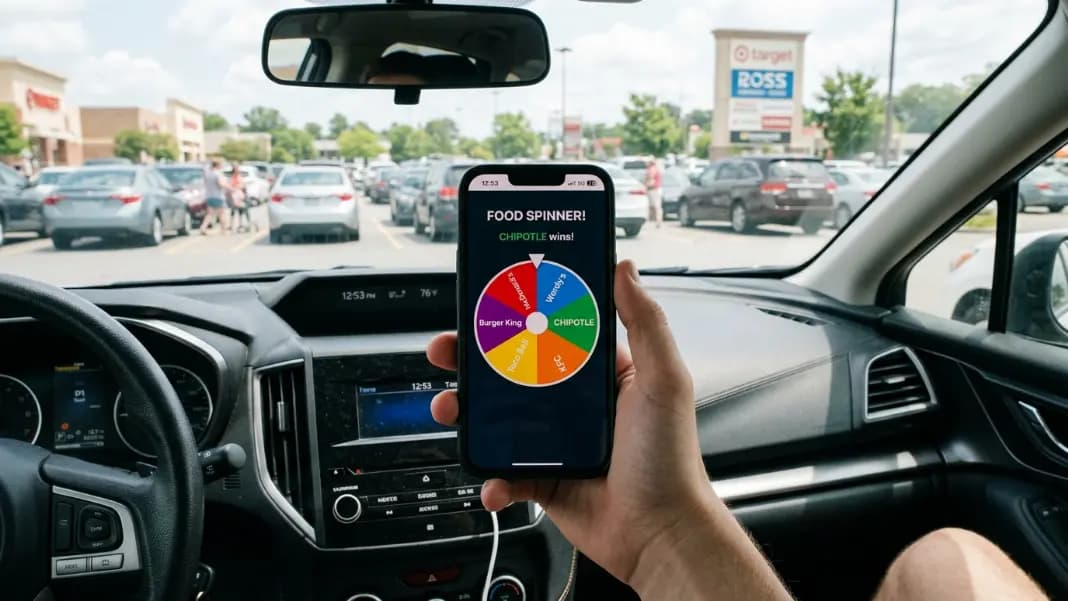
A fast food wheel spinner resolves this without any discussion. Put the chains that are nearby and open on the wheel. Spin. Drive.
Common options to consider: McDonald's, Chick-fil-A, Chipotle, Subway, Burger King, Wendy's, Taco Bell, Panda Express, Five Guys, Popeyes, Raising Cane's.
Add only the ones the group would actually visit. If Subway is technically nearby but nobody is enthusiastic about it, leave it off. The wheel should represent choices the whole group has genuinely agreed to accept.
The fast food spinner is particularly useful when one person is driving and does not want to pick. The driver can say "the wheel decided" and that is a more acceptable answer to passengers than "I wanted it." The wheel creates neutral authority.
For groups driving separately to meet somewhere, running the wheel before anyone starts driving prevents the situation where half the group is already at one place while the rest are still debating.
Restaurant Wheel Spinner for Groups Who Cannot Agree
Three or more people choosing a restaurant is one of the most reliably frustrating group decisions. The veto game works by eliminating options one by one: "not pizza again," "I just had Thai yesterday," "that place is too far." It runs until exhaustion, not until consensus.
The food wheel short-circuits the veto game by reversing the process. Instead of eliminating options until one is left, you build a list of options everyone can accept before the decision starts, and then the wheel picks from that pre-approved list.
Build the wheel before anyone has a chance to veto anything. Add six to ten restaurants the whole group has eaten at before and would eat at again. Spin once. That is the restaurant.
The key is building the list at a neutral moment, not mid-conversation when people are already hungry and opinionated. If you build the list while the veto game is already running, the veto game just moves to the list-building phase. A pre-built saved wheel used when the question comes up is more effective than building one on the spot.
For recurring groups, such as coworkers who eat lunch together or friends who meet weekly, a saved wheel configuration updated quarterly is more useful than rebuilding from scratch each time. Add places that opened recently, remove places that closed or fell out of favour. The wheel improves over time as the list gets refined.
Dinner Wheel Spinner for Weekly Meal Planning
A dinner wheel used consistently each week eliminates one of the smallest but most recurring friction points in a household: deciding what to make tonight.
Load the wheel with 10 to 14 dinner options you rotate through regularly. Spin on Sunday evening to plan the full week, or spin each day to decide one meal at a time. Either approach works depending on how much planning the household prefers.
The wheel does not prevent repeats on its own. If the same result comes up twice in a week and that bothers you, cross it off after using it and run the wheel without that segment until the week resets. The wheel spinner online guide covers how to save and share wheel configurations if you want a setup that reloads without re-entering entries each session.
Options for a household dinner rotation: Spaghetti bolognese, Sheet pan chicken, Fish tacos, Vegetable stir fry, Homemade burgers, Lentil soup, Grain bowls, Roasted salmon, Quesadillas, Pasta with sauce, Frittata, Thai curry, Rice and beans, Pork chops with vegetables.
The meal planning wheel does not replace grocery planning. Once the wheel picks the week's meals, you still need to check what is in the fridge and buy what is missing. But it removes the daily "what should we make" conversation, which compounds in value once you stop having it every evening.
The Rule That Prevents Spin Regret
Spin regret happens when the wheel lands on an option and someone says "actually, maybe not that tonight." The result gets ignored or re-spun, and suddenly the wheel is not deciding anything. It is just a theatrical way to continue the same argument with an extra step.
The fix is one rule agreed on before the first spin: the result is final. No reveto, no "let's try again," no "I'm just not in the mood for that." The result stands.
If someone cannot eat an option for dietary or allergy reasons, remove it from the wheel before spinning. That is when to exclude things, not after seeing the result. Any option on the wheel is one the group has implicitly agreed to accept in advance.
This rule is what makes the wheel actually function as a decision tool. A wheel with no finality attached to its results is not solving the dinner debate. It is adding a spin step to the debate.
Food Wheel for Dietary Restrictions and Mixed Groups
The food wheel works for restricted diets because you control the list entirely. Only adding options that meet every person's requirements means every result is automatically valid for the whole group.
For a household with mixed dietary needs (one vegetarian, one person with a nut allergy, one person who avoids gluten), the cleanest approach is a shared wheel with options that work for everyone. Build the list from the intersection of what everyone can eat.
If the shared set is too small to produce enough variety, run parallel wheels. Each person has their own wheel with all options valid for them. When two results from different wheels match up as a compatible meal, that is what you make. When they do not, each person spins once more. This approach is more flexible than a single shared wheel and prevents any person from feeling their restrictions are overriding everyone else's choices.
For restaurant decisions with mixed dietary needs, add only restaurants where every person eating can find something on the menu. Remove any option that would require one person to sit and watch while everyone else eats. The wheel result should always be immediately actionable for the whole group.
Cuisine Roulette for Trying Something New
A food wheel can push you toward cuisines outside your regular rotation. Load it with options you have not tried yet, agree that whatever it lands on you will actually go to, and spin once a week or once a month.
Cuisines that rarely come up in ordinary food decisions but reward trying: Ethiopian, Georgian, Peruvian, Filipino, Levantine, Korean barbecue, Uzbek, Taiwanese. In most cities with reasonable food diversity, the gap between "cuisines you know exist" and "cuisines you have actually visited" is larger than people notice.
A rotation wheel with a "try something new" agreement works through that gap one spin at a time instead of always defaulting to the three or four options that feel familiar and safe.
For other situations where a random picker replaces a group decision that takes longer than it should, the random tools section covers the number generator, coin flip, and team generator. The food wheel handles what to eat. The wheel spinner handles any other list-based decision that runs into the same preference revelation problem.