You ask twelve people which project group they want to be in and within two minutes three people are upset, two have formed a private coalition, and one is already drafting a message to you explaining why the arrangement is unfair. The problem is not the people. The problem is giving them a choice when a choice was never necessary.
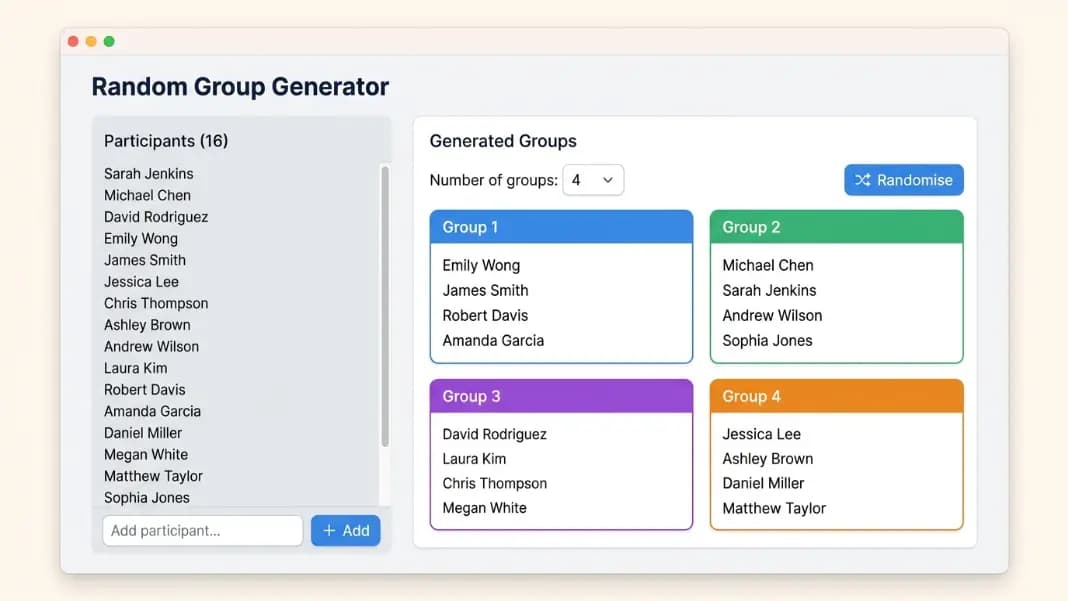
The random club generator removes the decision entirely. Enter the list of names, set the number of groups, and the tool splits them in seconds. Nobody picked their own group, nobody was sorted by the organiser's judgment, and nobody can credibly argue the result was designed to put them somewhere inconvenient.
This covers all the common use cases: sorting students into school clubs, running a competition league draw, dividing colleagues into workshop breakout groups, seeding fantasy sports league divisions, and anything else where a documented fair split matters more than a curated one. Each use case has its own nuances around sizing, seeding, and when random assignment is the right tool versus when it is not.
Why Manual Assignment Always Creates a Problem
When a person makes the groups, every participant interprets the result through the lens of whether that person favoured them or worked against them. Even a completely neutral organiser cannot fully escape this. If you put two friends in the same group, someone will say it was intentional. If you split two rivals into separate groups, someone will say you were managing their personalities rather than sorting randomly.
The randomness itself is only half the value. The other half is that the randomness is observable. When participants watch a generator run or see the documented output, they understand that the algorithm had no preferences, no history with the people involved, and no stake in the outcome. The result is determined by mathematics, not by anyone's judgment, and everyone in the room knows that before the generator finishes.
This matters most in high-friction situations: sports competitions with established rivalries, school assignments where friendship groups are strong and social dynamics are visible, workplace settings where team politics run close to the surface, and events where past manual assignments generated complaints that took time to resolve.
A random generator does not guarantee everyone is happy with their placement. Some people will always prefer a different group. What it does guarantee is that no one can credibly claim the assignment was manipulated, because there is no human decision for them to challenge.
For any recurring event where groups are reassigned each cycle, running a new generator draw each time also prevents the perception that the same people keep getting the same advantageous placements. A documented random draw at each cycle closes that complaint before it opens.
How to Use the Random Club Generator
The teams generator on ToolCenterHub handles club and group assignments in a straightforward sequence.
Enter the names of all participants in the input field, one per line. Set the number of groups you want to create. The generator distributes the names into equal-sized groups and handles the remainder automatically when the total does not divide evenly. Twenty-five names into four groups produces three groups of six and one group of seven, with the extra person assigned randomly rather than always landing in the same group position.
For situations where seeding applies, handle the seeding step manually before running the generator. If you are running a league draw where top teams should not all end up in the same group, assign the top seeds to separate groups first, then use the generator to fill the remaining positions within each group from the unseeded pool. This two-step process is how most organised sport competitions structure their official draws.
Run the generator, screenshot or export the result, and share it with participants. A timestamped screenshot with all names visible is evidence of a fair documented draw that you can reference if anyone questions the outcome. For ongoing programmes where participants rotate between clubs or groups each cycle, keep a record of each draw to show that no single person is repeatedly landing in the same placement.
The whole process from opening the tool to sharing the result takes under three minutes for most group sizes, which is considerably faster than any manual arrangement and produces no document trail of decisions that could be questioned later.
School and Education: Sorting Students Into Clubs and Study Groups
Teachers and school administrators use random club assignments to avoid the social dynamics that come with free choice or teacher-directed grouping. When students choose their own clubs or project groups, the resulting groups tend to mirror the existing social hierarchy. Established friendship groups stay together, students who are less socially connected end up selected last, and the more popular subjects or activities fill up quickly while others remain sparse.
Random assignment across subject clubs, extracurricular activities, or project teams distributes students more evenly and creates interactions that would not naturally form otherwise. Studies on mixed grouping consistently find that students from different social circles and varying ability levels working together produce broader thinking and more varied outputs than groups formed around existing social bonds.
For rotating club assignments across a school term, run a fresh generator draw at the start of each rotation period. A new random split each term ensures no student is repeatedly placed in the same group or stuck in the same club they disliked last time, which is a common complaint when teachers make the assignments manually and cannot remember every prior arrangement.
The generator handles standard class sizes accurately. A class of thirty split into six clubs of five, or five clubs of six, takes one generator run. The output can be printed or shared digitally as a record of the assignment, which is useful for administration and for responding to any parent or student questions about how groups were formed.
For larger programmes involving multiple classes or year groups, run the generator for each class separately to keep group sizes balanced within each class cohort.
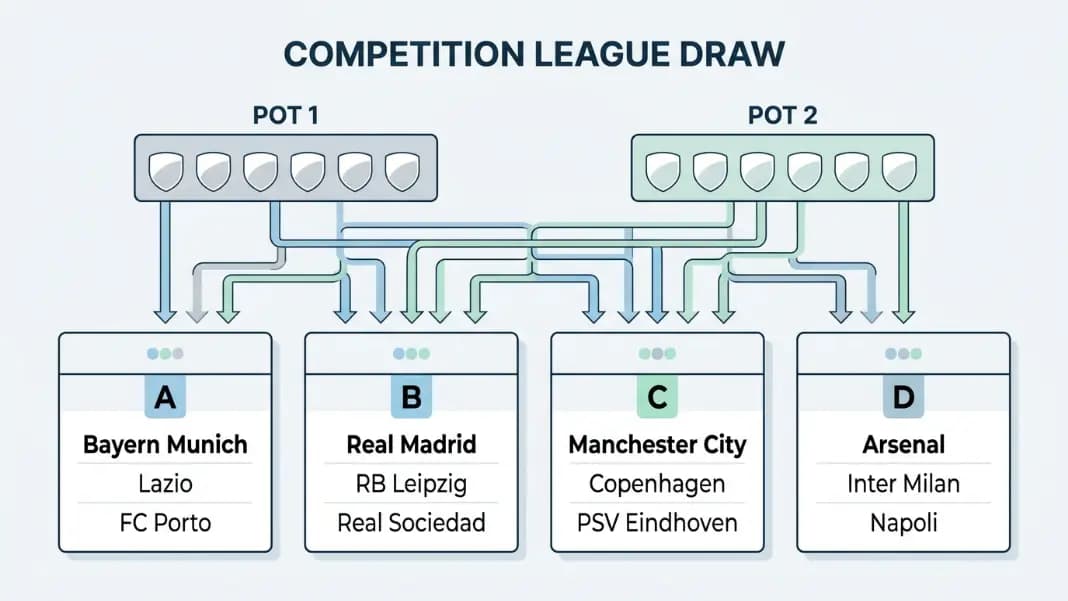
Competition League Draws and Tournament Group Stages
Sport and competition organisers use random draws for group stage assignments, conference splits, and league division placement. The purpose is always the same: distribute competitors across groups without concentrating the strongest participants in a single pool, which would create an uneven competition before the knockout stage begins.
The standard approach for seeded draws divides participants into pots. The top four seeds go into Pot 1, with one seed assigned to each group. The next tier goes into Pot 2, again one per group. The remaining participants fill the remaining slots randomly. This structure ensures every group contains exactly one top seed and prevents the situation where three or four of the strongest competitors are placed together while one group goes largely unopposed.
For unseed draws where no ranking applies, run the full participant list through the generator without any manual pre-assignment. Every team or participant has an equal probability of any group position.
For round-robin leagues, the generator can also randomise the fixture order within each group. After assigning teams to groups, enter each group's team list separately and use the generator to produce a randomised match schedule. This is faster than constructing a fixture schedule manually and removes any possibility that the fixture order itself was designed to benefit a particular team's preparation time.
The generator output works as an official draw record when shared with all participants immediately after the draw runs. Competition administrators in amateur leagues, school sports days, and community tournaments regularly use this as a free, accessible substitute for the broadcast draw formats used at professional level.
Workplace and Event Group Assignments
Corporate workshops, training sessions, and team-building events use random group assignments to break up existing clusters and produce cross-functional interaction. A sales team that always groups with sales, and a product team that always groups with product, produces outputs that largely reflect what would have come out of an ordinary departmental meeting. Mixed groups surface perspectives that separate-function groups would never encounter.
Random assignment for workplace events also removes the organiser from any accusation of political grouping. If two senior managers who have a known disagreement end up in the same group, the generator placed them there. If two people who need to work more closely end up in different groups, the generator made that call too. The organiser does not have to explain or defend either outcome.
For events with a networking focus, some facilitators run multiple rounds with fresh random assignments between sessions. Participants spend time with a different set of colleagues in each round, which distributes connection-building more evenly than any curated seating plan. The wheel spinner is useful for selecting individual participants for activities within an existing group, while the teams generator handles the full split across groups.
For large conferences or training programmes running parallel breakout tracks, the generator can assign participants to tracks quickly and produce a shareable list that functions as the participant's schedule for the event.
Fantasy Sports: Draft Order and League Division Seeding
Fantasy sports leagues use random generators at two distinct points: setting the draft order before the season starts and dividing a large participant pool into multiple league divisions.
Draft order assignment is the most visible use. In a fair fantasy league, every manager should have an equal chance at any pick position, from the coveted first overall selection down to the last pick. Assigning draft slots manually or leaving it to the league commissioner creates suspicion that the top picks were distributed to favoured participants. A generator that assigns positions randomly and produces a shareable result gives all managers documented evidence that the order was not predetermined.
The random number generator works well for a lottery-style draft format, where each manager is assigned a random number and those numbers determine pick order. For pre-assigned position slots, the teams generator assigns draft positions as group labels directly.
For leagues with more participants than a single division can support, the generator splits participants into balanced divisions of equal size. A 24-person league into four six-person divisions takes one generator run. Each division runs its own regular season, with top finishers from each division advancing to playoffs if the format includes a cross-division knockout round.
Running the division draw live in a shared video call or chat and sharing the generator output immediately afterward gives the split full transparency. No manager can question the division seeding because the result was generated in front of the group and everyone received the same output at the same time.
Club Generator vs Team Generator: Which Term You Actually Need
These two terms appear in searches for the same tool because the underlying function is identical: take a list of names and divide it into groups. The distinction is entirely about how you use the output afterward.
A team generator produces groups for a bounded activity. The groups play against each other, collaborate on a single task, or compete in a match. When the session ends, the groups dissolve. A team assignment is temporary and performance-focused.
A club generator produces groups for ongoing membership. Students are assigned to a club for a term. Employees are sorted into a cohort for a development programme. Sports teams are placed in a league division for a full season. The assignment persists for a defined period and carries social, administrative, or competitive implications beyond a single session.
The random tools section covers both use cases with the same generator. Whether you call the output a club, a group, a team, or a division depends entirely on the context you are running, not on the tool you use to create it.
For sports-specific assignments, particularly cases where skill-balanced teams matter more than equal probability, the random team generator guide for sports covers that workflow in detail, including how to structure a draw when purely random splits would produce obviously lopsided games.
If you need to account for specific constraints, such as keeping certain people out of the same group for logistical reasons, handle those constraints manually before running the generator. Place any fixed pairs or exclusions first, then fill the remaining positions with the generator. This hybrid approach preserves the fairness of the random draw while still accommodating real-world requirements.
The generator does not require an account, does not store names, and produces no output beyond the group assignment on your screen. Enter the list, set the groups, run the draw, and share the result. The assignment is done.