Two inches of snow closes every school in Atlanta. Six inches barely delays a school district in Buffalo. The difference is not stubbornness on one end or weakness on the other.
School districts make cancellation decisions based on snowfall accumulation, road conditions, temperature, wind, storm timing, and regional infrastructure. The same storm looks completely different to a superintendent in Mississippi versus one in Minnesota, not because the snow itself differs but because of what each district can actually handle safely.
The snow day calculator estimates whether school will cancel based on the conditions you enter: snowfall forecast, temperature, wind speed, road conditions, and your region. Use auto mode and it fetches the local forecast for you. Use it the night before a storm to check probability before the district announcement goes out.
This guide explains the six factors that drive snow day decisions, why regional thresholds vary so widely, what separates a 2-hour delay from a full cancellation, and what data to look at when a storm is approaching.
What Actually Determines Whether School Cancels for Snow
School cancellation is primarily a road safety decision, not a snowfall threshold. Superintendents and transportation directors are assessing whether school buses can safely travel every route in the district, not whether the school parking lot looks bad.
The six factors with the most weight in the decision:
Snowfall accumulation and rate. Total inches matter, but the rate of accumulation during the morning commute window matters more. Four inches that fall between 2:00 AM and 6:00 AM can be treated and plowed before buses run. Four inches falling between 6:00 AM and 9:00 AM during active morning routes is a fundamentally different situation.
Road conditions at the time of decision. This is the single most important variable. Transportation directors assess actual road conditions starting around 4:30 AM, sometimes driving district routes themselves. Roads that look passable may have black ice from overnight refreeze. Roads with treated surfaces may be safer than raw snowfall numbers suggest.
Temperature and wind chill. Cold temperature affects student safety at bus stops, walking conditions, and vehicle reliability. Districts with explicit cold-weather policies may trigger delays when wind chill hits minus 20 to minus 30 degrees Fahrenheit, regardless of how much snow fell.
Storm timing. A storm that ends by midnight and leaves roads clear for morning treatment is very different from one forecast to peak at 7:00 AM. Timing is one of the most underweighted factors when people try to predict cancellations from their windows the night before.
Existing snow on the ground. Compacted snow and ice from prior storms reduce road treatment effectiveness. A fresh 3-inch event on already-packed roads is more dangerous than 3 inches on clean pavement. Districts that used their plows three times in the previous week face different conditions than those starting fresh.
Ice content and freezing rain. Ice closes schools at lower accumulation thresholds than equivalent snowfall in every region. Freezing rain coats roads with a uniform ice layer that salt and gravel treat poorly. An ice storm with half an inch of accumulation cancels school in places where 5 inches of snow would produce only a delay.
How a Snow Day Calculator Works
A snow day calculator converts weather conditions into a cancellation probability by weighting the factors above against regional historical patterns.
The calculation at ToolCenterHub uses six weighted inputs: snowfall (30 percent of the probability score), road conditions (20 percent), storm timing (15 percent), temperature (15 percent), wind speed (10 percent), and existing snow on the ground (10 percent). Each input converts to a 0 to 100 subscale score. The weighted total is then adjusted for school type, since private schools typically require more snow to close than public schools and universities require substantially more than primary schools, and for regional norms.
The regional adjustment is where most calculators either oversimplify or get it right. Southern US regions carry a positive adjustment reflecting lower infrastructure capacity and lower driver experience. Northeast regions carry a slight downward adjustment because districts there are equipped and experienced with significant storms. Mountain regions vary by elevation. An ice storm applies a fixed positive adjustment regardless of region, because ice universally produces higher cancellation rates than equivalent snow accumulation.
The snow day calculator offers both auto and manual modes. Auto mode fetches live forecast data for your location and fills temperature, snowfall, wind, and ice storm fields automatically. Manual mode lets you enter a specific forecast scenario or adjust individual inputs. Either way, the result is a percentage: the probability that conditions like these historically result in school cancellations in your region.
Why Two Inches Cancels School in Georgia But Not in Minnesota
The disparity in regional thresholds is one of the most commonly misunderstood things about snow day prediction. People from high-snowfall regions often find Southern cancellation decisions difficult to understand. The explanation is practical, not cultural.
A school district in Buffalo, New York receives 100 or more inches of snow per year. The budget includes substantial investment in salt trucks, plows, trained drivers, and road treatment contracts. School bus drivers have years of experience navigating snow-covered routes. The infrastructure is built exactly for this situation, and the decision-making process reflects that.
A school district in suburban Georgia may see measurable snow once every 2 to 5 years. The budget for snow removal equipment is close to zero. Road treatment capacity is minimal. School bus drivers may have no personal experience driving in snow conditions. Under those constraints, closing at very low accumulation thresholds is the rational decision, because the district genuinely cannot operate safely regardless of what the accumulation total is.
Regional cancellation thresholds by approximate snowfall:
| Region | Typical delay threshold | Typical cancellation threshold |
|---|---|---|
| Southern US | 1 inch | 2 to 3 inches |
| Pacific Northwest | 1 to 2 inches | 2 to 4 inches |
| Mid-Atlantic | 2 to 3 inches | 4 to 6 inches |
| Midwest | 3 to 4 inches | 5 to 8 inches |
| Northeast | 4 to 6 inches | 8 to 12 inches |
| Mountain West | Variable by elevation | Ice more decisive than snow |
| Canada | 4 to 6 inches | 8 to 15 inches |
The Pacific Northwest entry surprises people who expect Seattle to handle snow more like a northern state. The region gets far more rain than snow. When snow arrives, it often comes mixed with sleet and freezing rain, roads in hilly areas ice quickly, and snow removal infrastructure is similarly limited to Southern states in practice.
The Difference Between a Full Day Off, a 2-Hour Delay, and Early Dismissal
These three outcomes reflect different assessments of how conditions will change across the school day, and understanding the distinction helps predict which outcome is more likely.
A 2-hour delay means road conditions are expected to improve with morning plowing, salt treatment, or rising temperatures. The superintendent believes routes will be operable by 9:30 to 10:00 AM rather than 7:30 AM. Delays are more common when a storm ends before midnight and the main challenge is clearing roads that froze overnight, rather than an active ongoing event during morning hours.
A full cancellation means conditions are expected to remain unsafe throughout the school operating window, or that the storm is forecast to be actively ongoing during morning routes, peak school hours, or afternoon dismissal. Ice storms nearly always produce full cancellations rather than delays because ice on roads does not improve reliably with moderate temperature rises on cold days. Freezing rain that continues through noon is a full cancellation regardless of accumulation total.
Early dismissal is the most disruptive outcome for families and the one superintendents try hardest to avoid. Calling it means buses run in whatever conditions arrive mid-day, which can be worse than either waiting or not starting. Schools that dismissed early during an active storm often end up running buses in the heaviest accumulation window. Most administrators prefer a proactive full cancellation to a reactive mid-day dismissal call.
For decisions with genuinely no data to work with, some people use a yes or no wheel for a quick random answer, or a coin flip for a clean 50/50 call. Snow day probability is different because the factors are real and quantifiable. The calculator gives a reasoned estimate tied to actual conditions rather than a random outcome.
What Weather Data to Check the Night Before a Storm
The most useful data points to check the evening before a potential snow day are not the ones most people look at first.
The headline snowfall forecast from a weather app is the least useful single number. Snowfall estimates shift frequently as storms approach and models update. A forecast for 6 inches at 6:00 PM can become 2 inches or 10 inches by the 11:00 PM run. The forecast range matters more than the midpoint estimate.
Timing of the storm onset and peak. If peak accumulation falls between midnight and 5:00 AM, conditions will be at their worst when the cancellation decision is made but may improve before buses run. If peak is forecast at 7:00 to 9:00 AM, the decision window and the worst conditions overlap directly.
Overnight low temperature. A hard freeze overnight creates ice from any prior moisture, even without active snowfall. Roads treated with salt in the evening can refreeze if temperatures drop far enough below the salt effectiveness threshold, roughly 15 to 20 degrees Fahrenheit.
Wind speed forecast. A 4-inch storm with 35 mph winds is a different road safety situation than a 4-inch storm with 5 mph winds. Wind reduces visibility, creates drifting on exposed roads, and compounds hazards independently of accumulation totals.
Freezing rain probability. Even small amounts of freezing rain produce disproportionate road hazard. Check the precipitation type breakdown in any forecast, not just the accumulation headline.
The auto mode on the snow day calculator pulls current forecast data automatically for your location from Open-Meteo. Temperature, snowfall, wind speed, and ice storm probability are filled in without manual lookup. Enter your school type, check the timing and road conditions fields, and run the calculation before going to sleep. The probability it returns is more specific than any general weather alert.
Why Snow Day Predictions Are Harder Than They Look
Probability tools can only estimate based on general patterns. Several factors that consistently affect actual decisions are outside any calculator's reach.
Forecast accuracy at the moment of decision. The superintendent announces at 5:00 AM based on what the forecast shows at 4:30 AM. If that forecast has been consistently off throughout the storm's track, the actual decision may not match what ultimately happens by noon. Superintendents develop calibrated skepticism about certain model tendencies over years of experience in their specific geography.
The specific bus route problem. A district cancellation is based on whether every route can operate safely. If one rural route through an unplowed township road is impassable, the entire district may close even if 80 percent of routes are fine. No external tool can model your district's specific route vulnerabilities.
Superintendent judgment and prior commitments. Districts that have already used most of their allowed snow days face pressure toward delays rather than cancellations. Districts with a superintendent who makes conservative early decisions cancel at lower thresholds than regional averages suggest. These factors are invisible to any outside calculation and account for a significant share of district-to-district variation.
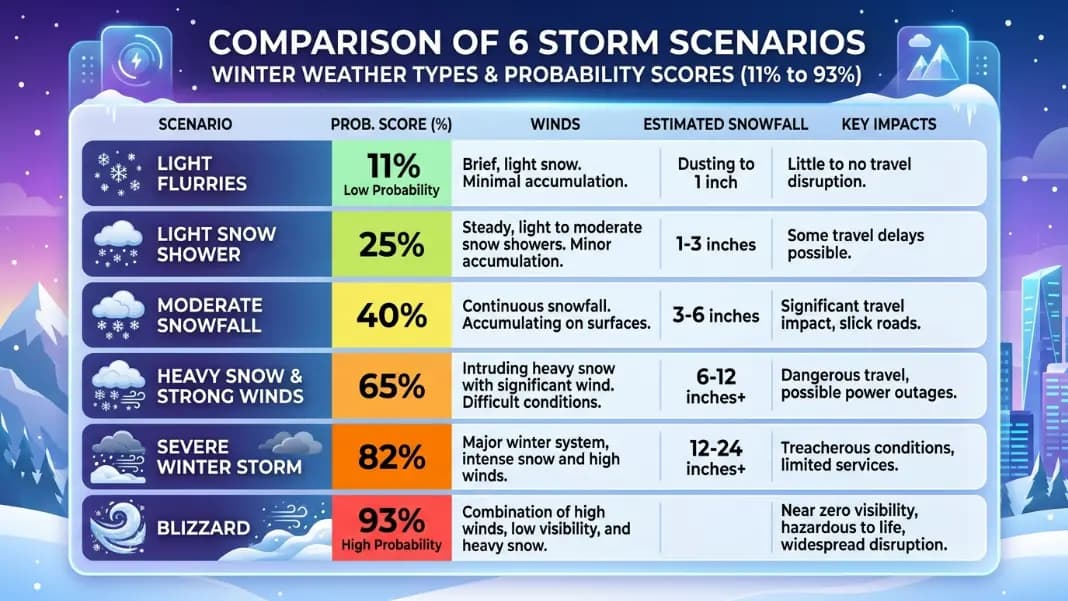
The look-ahead problem. A 5-inch storm in isolation may show 65 percent probability. If a second, more severe storm is forecast for two days later and the district wants to preserve a snow day for it, the current decision may trend toward delay. That forward-looking consideration does not appear in any weather model.
The snow day calculator is genuinely useful as a probability framework that weights the factors that matter historically. It gives a more structured and accurate estimate than gut feeling or watching the weather channel. The random tools section at ToolCenterHub also includes decision aids like the wheel spinner and coin flip for situations without real data behind them. Snow days are not one of those situations: the factors are real, regional patterns hold over time, and checking the probability the night before is a better strategy than waiting for a notification at 5:30 AM.