Calories tell you how much energy you consume. Macros tell you what that energy is made of. Two people can eat 2,000 calories per day and have completely different body composition results depending on how those calories are split between protein, carbohydrates, and fat.
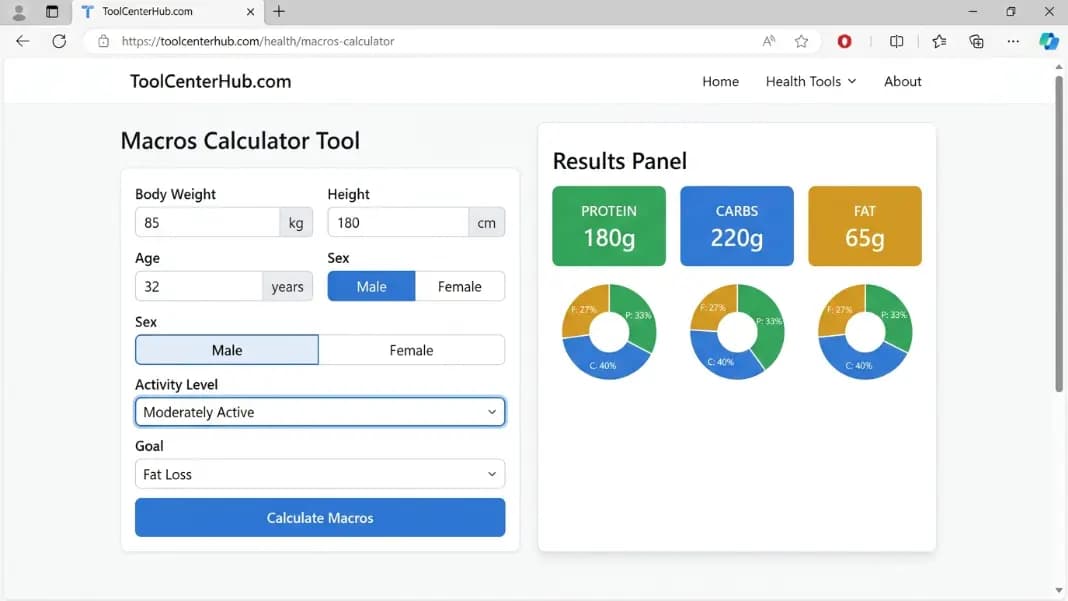
The macros calculator at ToolCenterHub takes your weight, height, age, activity level, and goal, then outputs specific daily gram targets for protein, carbs, and fat. Enter your details and the targets are calculated immediately without any account required.
This guide explains how macro calculation works, why the protein number matters most, how to set the right split for fat loss or muscle gain, and how to adjust when the numbers stop producing results.
What macros actually are
Macros is short for macronutrients: the three nutrients that provide calories. Protein, carbohydrates, and fat are the only macronutrients. Alcohol contains calories but is not a macronutrient in the standard sense since it has no nutritional function equivalent to the other three.
Protein and carbohydrates each contain 4 calories per gram. Fat contains 9 calories per gram. Every food you eat delivers some combination of all three, and the calorie total of any food is the sum of its macro components.
Tracking macros means setting a specific daily gram target for each nutrient and logging intake to hit those targets. This gives more control over body composition than calorie counting alone because the ratio of macros affects which kind of weight you gain or lose, how much muscle you retain during a deficit, and how full you feel throughout the day.
Why macros matter beyond total calories
Total calories drive weight change. Eat more than you burn and you gain weight. Eat less and you lose it. That relationship holds regardless of macro split.
But weight change is not the same as body composition change. Someone who loses weight on a very low protein diet will lose a mix of fat and muscle. Someone who loses the same amount of weight on a high protein diet will lose mostly fat. The scale shows the same result; the body looks and performs very differently.
Protein has a higher thermic effect than carbs or fat, meaning your body burns more calories digesting it. It is also the most satiating macronutrient per calorie, which makes staying in a calorie deficit easier when protein intake is high.
Carbohydrates are the primary fuel for high-intensity exercise. When carb intake is too low during a strength training program, workout performance drops, recovery slows, and the signal to retain muscle weakens. Fat supports hormone production, including testosterone and estrogen, and is required for absorbing the fat-soluble vitamins A, D, E, and K.
The right macro split puts each nutrient at a level where it does its job effectively, rather than cutting one too low to prop up another.
Step 1: Find your TDEE
Every macro calculation starts with your total daily energy expenditure, the number of calories your body burns in a day when you account for your activity level.
The TDEE calculator calculates this from your weight, height, age, sex, and how often you exercise. A sedentary 80 kg man might burn 2,200 calories per day. The same man training five days per week might burn 3,000 or more. The difference matters because macro targets are set as a percentage of total calorie intake, and total calorie intake is derived from TDEE adjusted for your goal.
Getting TDEE right is the foundation. A rough estimate will produce rough macro targets. Use the calculator and be honest about your actual activity level rather than rounding up.
Step 2: Set your calorie target
Your calorie target depends on your goal. For fat loss, you create a deficit below TDEE. For muscle gain, you eat above it. For maintenance, you match it.
A moderate deficit for fat loss is 300 to 500 calories below TDEE. This produces roughly 0.3 to 0.5 kg of fat loss per week without causing the muscle loss or metabolic adaptation that comes with more aggressive cuts.
For muscle gain, a surplus of 150 to 300 calories above TDEE is enough for most people who are not new to training. Larger surpluses produce faster scale gains but a higher proportion of that gain is fat rather than muscle. New trainees can often gain muscle even in a slight deficit for the first few months before this tradeoff becomes significant.
The calorie calculator gives a clear view of your daily energy needs alongside TDEE so you can set the right target for your situation.
Step 3: Set protein first
Protein is the macro you set first, and it is the one you do not compromise on.
The research-supported range for most active people is 1.6 to 2.2 grams of protein per kilogram of body weight. For a 75 kg person, that is 120 to 165 grams of protein per day. At the higher end, around 2.2 grams per kilogram, the benefit is mostly for people in a significant calorie deficit where muscle preservation becomes harder.
At 4 calories per gram, 150 grams of protein accounts for 600 calories of your daily target. Those calories are now allocated. The remaining calories go to fat and carbohydrates.
Setting protein first also shapes how you approach meals. A target of 150 grams of protein means roughly 35 to 50 grams per meal across three meals plus a snack. That volume requires intentional food choices, primarily animal proteins, legumes, dairy, or protein supplements, rather than hoping protein accumulates passively.
Step 4: Set fat and distribute carbohydrates
After protein is set, the remaining calories are split between fat and carbohydrates. There is no single correct ratio. Both low-carb and higher-carb approaches produce fat loss at matched protein and calorie levels. The split should reflect what you can sustain consistently.
General starting points:
For fat loss, a common starting split is 25 to 35 percent of remaining calories from fat and the rest from carbohydrates. At this level, fat intake is sufficient for hormone function without being so high that carbohydrate availability for exercise becomes a problem.
For muscle gain, a higher carbohydrate allocation, 40 to 50 percent of total calories, supports the training volume and recovery demands that come with consistent strength work.
For lower-carb approaches, fat is increased to 40 to 50 percent of remaining calories, with carbohydrates making up 20 to 30 percent of total intake. This works well for people who find appetite control easier when carbs are low, or for those who do not do high-intensity training regularly.
A minimum fat intake of around 0.8 to 1 gram per kilogram of body weight is a practical floor to protect hormone function. Going significantly below this level for extended periods can disrupt testosterone and estrogen production.
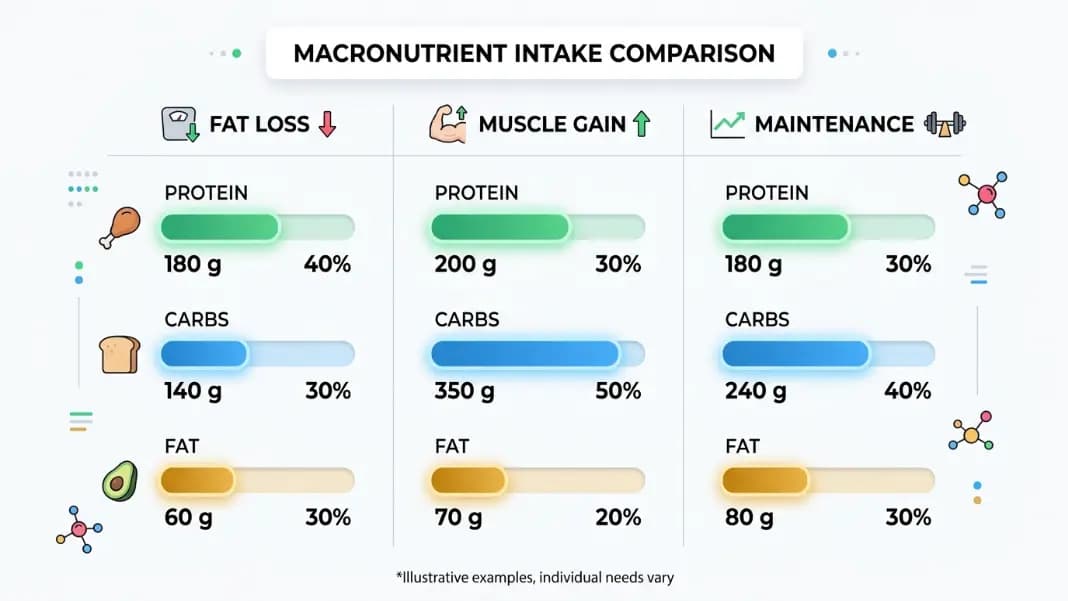
Macro ratios for specific goals
The macros calculator produces specific ratios based on your inputs, but knowing what the ratios mean helps you interpret and own the numbers.
Fat loss: A typical fat loss split for someone training 3 to 4 days per week runs around 35 to 40 percent protein, 25 to 30 percent fat, and 30 to 35 percent carbohydrates as a share of total calories. This keeps protein high enough to preserve muscle, fat high enough to avoid hormonal issues, and carbohydrates available for training.
Muscle gain: For muscle gain, carbohydrates take a larger share. A common setup is 25 to 30 percent protein, 20 to 25 percent fat, and 45 to 55 percent carbohydrates. Total protein in grams is still high, but because total calorie intake is higher, protein as a percentage of the total is somewhat lower.
Maintenance: At maintenance, the split is more flexible. Around 25 percent protein, 25 to 30 percent fat, and the remainder in carbohydrates covers the bases for most people without requiring precision. Maintenance eating is less demanding to track, and many people at this stage move toward intuitive eating with occasional spot-checks rather than daily logging.
For body composition reference alongside your macro targets, the body fat calculator gives a baseline measure of your current fat percentage to track progress beyond the scale.
How to adjust when progress stalls
Macro and calorie targets are starting points, not permanent prescriptions. Bodies adapt over time, and a target that worked for the first six weeks may stop producing results.
For fat loss plateaus, the first step is auditing tracking accuracy. Research consistently shows that people underestimate food intake, sometimes by 20 to 40 percent, particularly with oils, sauces, and processed foods that are calorie-dense and easy to underestimate by volume. If tracking is genuinely accurate, reduce total calories by 100 to 200 per day. Take the reduction from carbohydrates or fat, not protein.
For muscle gain plateaus, check whether you are consistently hitting your calorie target. Under-eating is the most common reason muscle gain stalls. If calories are on target, a slight increase of 100 to 150 calories per day can restart progress. The second factor is training: calorie adjustments alone do not produce muscle if the training stimulus is insufficient.
Reassess every four to six weeks rather than making changes weekly. Short-term fluctuations from water retention, digestive content, and hormonal cycles can mask real trends. Four weeks of data gives enough signal to distinguish a true plateau from normal variation.
Tracking macros in practice
Hitting a macro target requires logging food in a tracker that shows macronutrient data. Apps that scan barcodes and pull nutritional databases make this reasonably quick once you establish your common meals.
The most practical approach is to plan meals before eating them rather than logging as you go. When you know what you are having that day, you can see whether the totals hit your targets and adjust before the meal rather than after. This takes two to five minutes in the morning and eliminates the end-of-day scramble to compensate for missing protein.
Protein is the hardest target to hit consistently without planning. Structure each meal around a protein source first. For fat loss, that means chicken, fish, lean beef, eggs, Greek yogurt, cottage cheese, or legumes at every meal. Carbs and fat fill in around whatever protein allows.
For a complete view of how daily calorie needs connect to macro targets, the guide to TDEE explains how total expenditure is calculated and how it changes with different activity levels. The calorie calculator guide covers how to set the right calorie target before distributing those calories across macros.
When macros are not the right tool
Macro tracking adds precision and requires effort. For some people and situations, it is not the right approach.
People with a history of disordered eating should approach macro tracking carefully. The precision that makes macros effective for body composition can amplify obsessive tendencies around food. Calorie-free approaches to improving diet quality, such as increasing protein and vegetables without counting, can produce meaningful results without the framework of numerical targets.
Macro tracking also requires stable eating environments. Frequent travel, shared cooking responsibilities, or irregular meal timing make accurate logging genuinely difficult. In those situations, rough targets, primarily a high-protein emphasis with awareness of total portions, can produce similar results with far less friction.
For most people who want to improve body composition and are willing to spend five to ten minutes a day on tracking, macros provide a clear and adjustable system that calorie counting alone does not.
All health calculators, including the macros tool, TDEE calculator, and body fat calculator, are available at the health tools hub and run entirely in the browser with no account or app required.